Every clever thing a [conversation intelligence platform](/en/compare/best-conversation-intelligence-platforms) does - the summaries, the classifiers, the dashboards, the alerts - depends on one quiet, unglamorous step happening first. The call has to become text. This article explains how the transcription engine does that under the hood, because the quality of that text sets a ceiling on the quality of everything built on top of it.
Want the capability itself, not just the explanation? Nivision's call transcription service page brings the transcription, classification and analysis together end to end.
What a transcription engine actually does
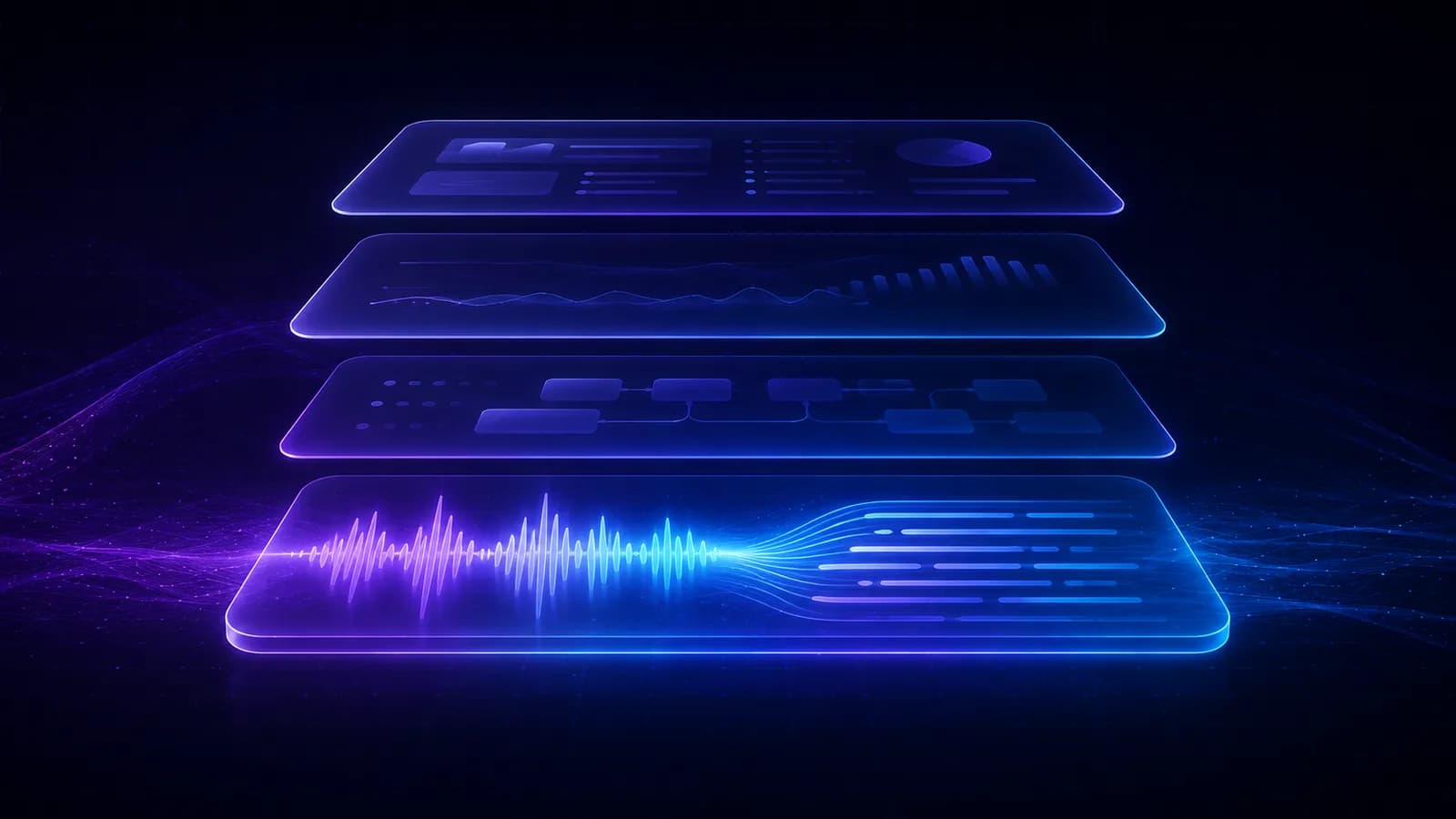
A transcription engine converts a spoken conversation into a written, time-stamped, speaker-attributed transcript. A modern engine does not just produce a wall of words. It does several things at once:
- Speech-to-text - turning audio into words, handling overlapping speech, background noise, hold music and crosstalk.
- Speaker diarization - deciding who said what, so the agent's words and the customer's words are separated.
- Time alignment - anchoring each segment to a moment in the recording, so a line of text links back to the audio.
- Punctuation and segmentation - adding the sentence structure that makes a transcript readable, and that downstream models rely on.
The output is not a recording you could listen to. It is a structured document a machine can read - and that distinction is the entire point.
Why Hebrew-native accuracy matters
Most transcription engines were built English-first, with other languages bolted on afterwards. For a Hebrew-speaking call center, that is not a minor inconvenience - it is a structural problem.
Hebrew has its own challenges: rich morphology, words that change meaning with a single prefix, heavy use of abbreviations and acronyms, and real-world calls that mix Hebrew with English brand names, product terms and the occasional Arabic or Russian phrase. An engine trained mostly on English will mangle exactly the words that matter most - a customer's name, a product, a policy number, the specific objection.
A transcription error is not random noise. It tends to land on the proper nouns and domain terms that carry the meaning of the call.
This is why Hebrew-native accuracy is a requirement, not a nice-to-have. Nivision is built Hebrew-first: its speech-to-text engine is trained specifically on Hebrew, tuned for how Israeli call centers actually speak, including the code-switching and the domain vocabulary. When the transcript is right, everything downstream has a chance of being right. When it is wrong, every layer above inherits the error.
The transcript is the foundation, not the product
It is tempting to treat the transcript as the deliverable. It is not. A transcript on its own has the same problem as a recording: nobody is going to read thousands of them. The transcript is valuable because it is machine-readable - it is the raw material the rest of the platform consumes.
Consider what each layer needs from it:
Summaries read the transcript to compress a call into a few sentences. If the transcript drops the resolution, the summary is wrong with confidence.
Classifiers read the transcript to extract structured fields - call type, outcome, objection raised, whether a disclosure was read. A misheard phrase becomes a miscategorized call, and a miscategorized call quietly corrupts a dashboard.
AI chat over your call data answers questions by searching across transcripts. If the customer said "cancel" but the transcript says something else, that call simply will not surface when you ask about cancellations.
Search and knowledge base features depend on the words being the words. You cannot find what was never written down correctly.
Every one of these is downstream of transcription. That is what "foundation" means here: errors do not stay contained, they propagate.
Accuracy you can actually trust
So how should a call-center manager think about transcription quality? A few practical points.
Accuracy is uneven, and the hard parts matter most
Overall word accuracy is a misleading number. A transcript can be 95% accurate and still miss every product name, because the easy words - "the", "and", "yes" - are common and the hard words are rare. Judge an engine on the words that carry meaning.
Speaker separation is half the value
A transcript that knows the agent said one thing and the customer said another is far more useful than an accurate but undifferentiated block of text. Almost every downstream analysis - was the script followed, who raised the objection, who proposed the resolution - depends on diarization being right.
Transcription is post-call, and that is fine
Nivision transcribes and analyzes calls after they end, not live during them. For the work a call center actually does - spotting patterns, coaching, trending, alerting on what happened today - post-call transcription is exactly the right model. The value is not millisecond latency; it is having an accurate, complete record of 100% of calls, every day, ready for analysis.
The takeaway
The transcription engine is the least visible part of conversation intelligence and the most important. It is the step that turns your most abundant source of customer truth - the calls themselves - into something a machine can read, count and reason over. Get it right, in the language your customers actually speak, and every layer above it has a foundation worth building on. Get it wrong, and you are scaling errors. For a Hebrew-speaking call center, that makes Hebrew-native transcription accuracy the first question to ask - long before the dashboards.
Get conversation-intelligence insights
Practical writing on call-center performance, QA and coaching - straight to your inbox.