
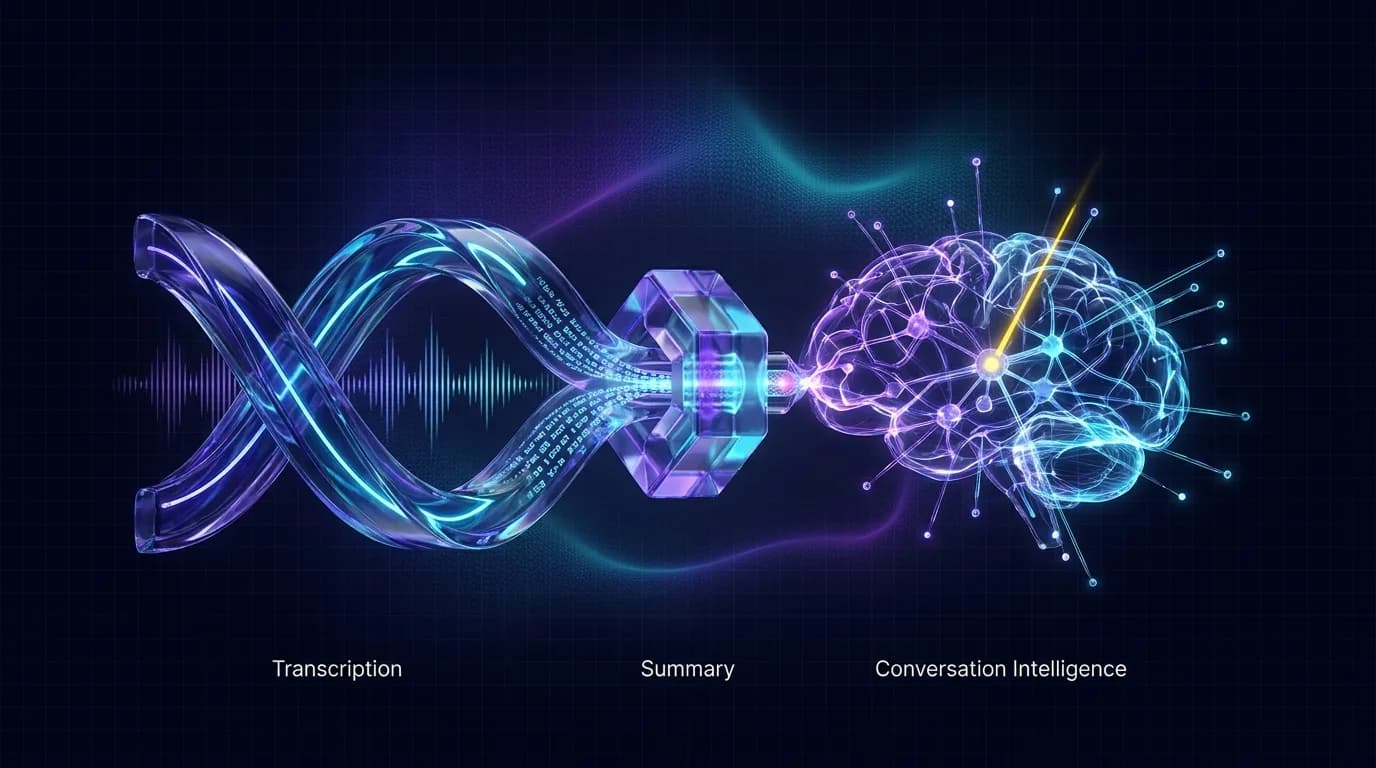
"Transcription," "summary," and "Conversation Intelligence" — three terms that appear in every AI vendor's sales pitch for call centers, often presented as if they were the same thing. They aren't. Each solves a different problem, and call centers making a purchase decision benefit from knowing exactly what separates them — before paying for a feature they don't need.
Transcription — turning audio into text
Transcription is the automatic conversion of a call recording into clean text. It is the foundation — without accurate transcription, nothing else is possible with the call.
Good transcription includes speaker separation (agent vs customer), word-level timestamps, and handling of background noise and mild speaker overlap. For Hebrew call transcription specifically, it has to be based on a Speech-to-Text model trained on Hebrew — not a translation from an English model.
What transcription does not do: it does not decide what matters in the call, does not summarize, classify, alert, or sync to a CRM. It gives you the text — what you do with it depends on the tools above it.
Summary — a short description of the call
A call summary is a short text describing what happened in the call. It builds on the transcription and adds value: instead of reading 15 minutes of dialogue, you read 4-5 lines.
A high-quality call summary is not a generic paraphrase of the transcript. It is classifier-driven: each call type (discovery, meeting, closing, retention) gets its own summary template with the relevant fields — deal size, decision-maker, key objection, follow-up date.
What summary does not do: it does not let you search for patterns across thousands of calls, does not present an operational dashboard, and does not send real-time alerts.
Conversation Intelligence — the operational action layer
Conversation Intelligence (CI) is the category of software that takes transcripts and summaries, analyzes patterns across thousands of calls, and acts on what it finds. It is the layer that turns information from calls into operational action.
A full CI platform includes:
- Pattern analysis across large volumes: which objections recur, where deals slip, which reps close best
- A live operational dashboard that shows managers what is happening in real time
- Conditional alerts the moment something matters happens
- Automated reports delivered daily, weekly and monthly
- Automatic sync to the CRM and other systems
CI is what separates "we have transcripts" from "our call center is learning from its calls."
Which of the three do you need?
It depends on one question: what do you want to do with the calls?
- Just compliance recording? Transcription alone is enough.
- Records + summaries in the CRM? Transcription + summary.
- Act on what is happening in the call center, see patterns, and measure performance? You need full Conversation Intelligence.
The common mistake: buying a "transcription tool" to solve a CI problem. Transcription alone won't deliver operational ROI. The reverse mistake — buying a full CI platform when only documentation is needed — creates a cost that does not justify itself.
If you're undecided between categories, our comparison guide breaks down the three tool categories, the pros and cons of each, and offers a structured decision framework.
Get conversation-intelligence insights
Practical writing on call-center performance, QA and coaching - straight to your inbox.